
Pitt Pediatrics congratulates Pengcheng Shang, PhD, for his recent first-author publication in Cell Host and Microbe, titled “NRP1 is a receptor for mammalian orthoreovirus engaged by distinct capsid subunits.” Shang is a research instructor of pediatrics in the Division of Infectious Diseases as well as part of the Institute for Infection, Inflammation, and Immunity in Children (i4Kids). 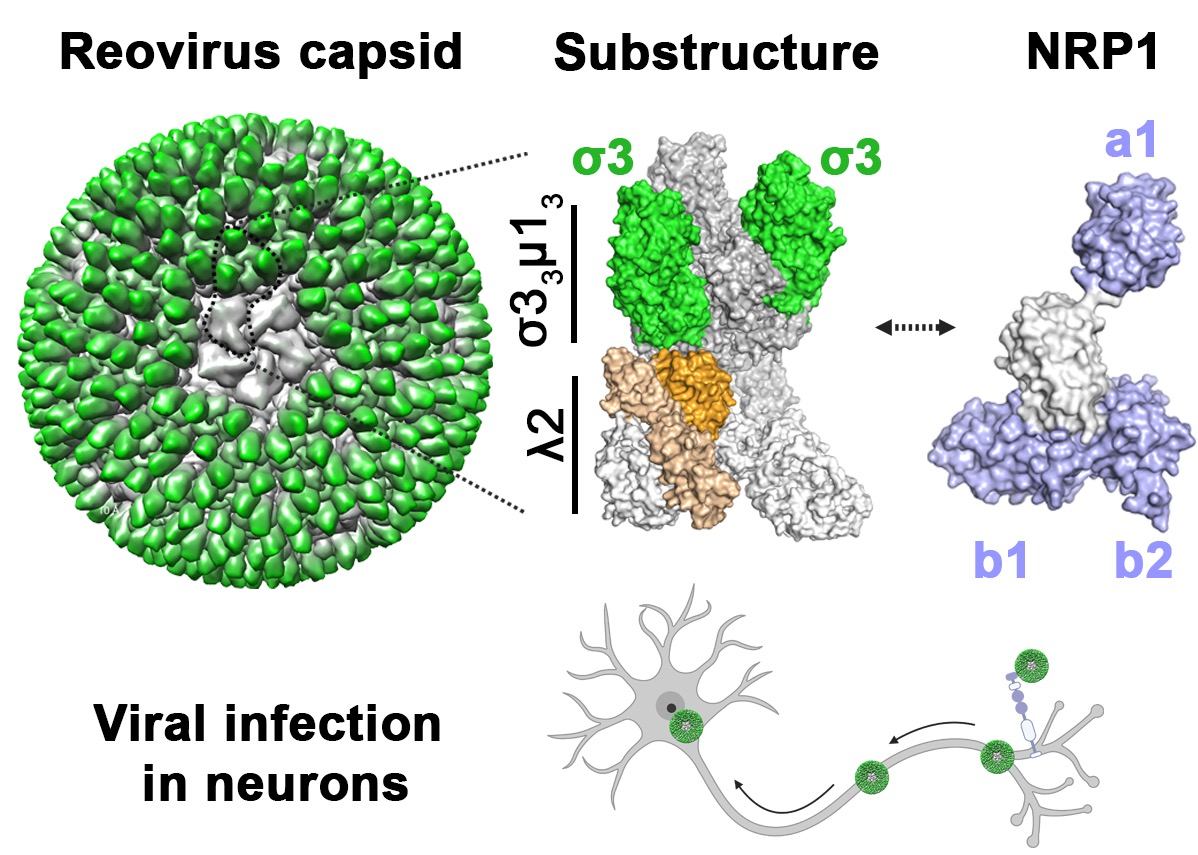
Terence Dermody, MD, the Vira I. Heinz Distinguished Professor and Chair of the Department of Pediatrics, as well as the founder of i4Kids, served as the last author. Middle authors include Rita Dos Santos Natividade, Ankita Ray, and David Alsteens (Louvain Institute of Biomolecular Science and Technology), as well as Gwen Taylor, PhD, Olivia Welsh, MS, Kay Fiske, BS, and Danica Sutherland, PhD, (all of i4Kids and the Dermody Lab in the Division of Infectious Disease).
In this the study, the Dermody Lab and affiliated authors aimed to address the unclear mechanism by which mammalian orthoreovirus (reovirus) disseminates systematically and targets neurons once it has established its primary infection in the intestine. The group soon identified that murine neuropilin 1 (mNRP1) as a receptor for reovirus through a complicated binding mechanism coordinated by multiple interactions between distinct reovirus capsid subunits and multiple NRP1 extracellular domains.
These capsid subunits mediate the multivalent interaction between the receptor and the virus. Ultimately, by using capsid mutants incapable of binding NRP1, the lab found that NRP1 contributes to reovirus dissemination and neurovirulence in mice. Collectively, results demonstrate that NRP1 functions as an entry receptor for reovirus while also uncovering other mechanisms by which NRPs promote viral entry and pathogenesis.
Follow Pitt Pediatrics on Twitter and Instagram for more updates on exciting new research in infectious disease.